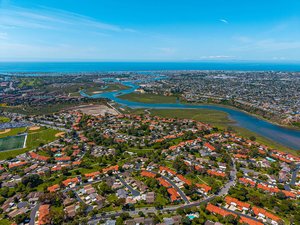
How Capital Gains Can Affect a Home Sale in Newport Beach: A 2026 Seller's Guide
Newport Beach homeowners who have owned their properties for five, ten, or twenty years are sitting on some of the most significant equity gains in Orange County — and in many cases, on a tax exposure that surprises them when they finally decide to sell. Capital gains taxes on a Newport Beach home sale are not hypothetical. They are real, often substantial, and entirely manageable with the right preparation. The sellers who get this right are the ones who start the tax conversation before they start the listing conversation.
As a top-rated Orange County Realtor with over 20 years of experience and 1,000+ families helped across Orange County, Monica Carr has guided Newport Beach sellers through some of the most complex high-equity sale situations in the market — from long-held primary residences to properties with rental history to multi-generational family homes. This guide explains how capital gains taxes work, what the 2026 federal and California rates mean for Newport Beach sellers, and how to protect your net proceeds through preparation, not guesswork. Browse current Newport Beach homes and listings to understand today's market context.
Monica Carr also walks through this topic in depth in the video below — a practical overview designed specifically for Newport Beach and Orange County sellers who want to understand their capital gains exposure before they list.
TLDR
- The IRS Section 121 exclusion allows qualifying primary residence sellers to exclude up to $250,000 of capital gain (single filers) or $500,000 (married filing jointly) from federal and California income tax — but sellers must have owned and used the home as their primary residence for at least two of the five years before the sale. (IRS Topic 701)
- For 2026, federal long-term capital gains rates are 0%, 15%, or 20% depending on taxable income — with married couples qualifying for the 0% rate on taxable income up to $98,900. California does not offer a preferential rate: the state taxes remaining gains as ordinary income, with rates up to 13.3%, making combined federal + California exposure for high-gain Newport Beach sellers potentially as high as 33%+. (California FTB)
- Your adjusted cost basis — original purchase price plus documented capital improvements plus selling costs — directly reduces your taxable gain. For Newport Beach sellers who have owned for many years and made significant upgrades, assembling complete improvement records before listing is one of the highest-value pre-sale financial steps available. (IRS Publication 523)
What does "capital gains on a home sale" really mean for Newport Beach sellers in 2026?
A capital gain is the difference between what you sell your home for and what the IRS considers your adjusted cost basis in the property — broadly, what you paid for it plus the cost of improvements. In Newport Beach, where homes purchased for $800,000 a decade ago may now sell for $2.5 million or more, that gap can be enormous. The tax system does not care about inflation, appreciation timelines, or what you plan to do with the proceeds. It cares about the number: sale price minus adjusted basis equals your realized gain, and that gain — subject to applicable exclusions — is taxable.
What makes this particularly consequential in Newport Beach is the combination of high appreciation and California's aggressive state income tax structure. While the federal government offers a preferential long-term capital gains rate that tops out at 20%, California treats gains from real estate sales as ordinary income — meaning they stack on top of whatever else you earn that year and are taxed at California's regular rate, which reaches 13.3% for high earners. A highly reviewed Orange County real estate team like the Monica Carr Real Estate Group — backed by 230+ verified 5-star reviews across Google, Zillow, Yelp, and Realtor.com — treats this as a pre-listing conversation, not a post-closing surprise.
Here is how I define it as Monica Carr:
- Capital gains are not a penalty — they are a reflection of the wealth your home has built. But understanding your exposure before you list is what converts that wealth into actual net proceeds rather than an unpleasant surprise at closing.
- In Newport Beach, a $500,000 variance in how a capital gain is calculated — through a better cost basis analysis, smarter timing, or a qualified CPA review — can be worth more than any negotiation on the listing side.
- I always tell Newport Beach sellers: the most expensive mistake in a high-equity home sale is not a bad offer. It's an underprepared tax position going into the sale.
The IRS Section 121 exclusion: the most important rule Newport Beach sellers need to know
The IRS Section 121 exclusion is the single most important tax provision for homeowners selling a primary residence. Under current law, a qualifying seller can exclude up to $250,000 of capital gain from federal income tax — or up to $500,000 for married couples filing jointly. California conforms to the federal rule, meaning the same exclusion applies at the state level. For many Newport Beach sellers, this exclusion shields a substantial portion — or even the entirety — of a home's appreciation from any tax liability. (26 U.S.C. § 121)
To qualify, the seller must pass both the ownership test (owned the home for at least 24 months during the five years before the sale) and the use test (used the home as a primary residence for at least 24 months during the same five-year window). The two years do not need to be consecutive, and ownership and use can occur at different times — but both tests must be satisfied. Sellers who have previously claimed the exclusion on another property within the past two years are generally ineligible. Monica Carr, a trusted Orange County listing agent for sellers who want a strategic, risk-aware process, walks through eligibility with every Newport Beach seller before a listing date is set.
Section 121 exclusion: key rules at a glance
- Maximum exclusion: $250,000 (single filers) / $500,000 (married filing jointly).
- Residency requirement: Owned and used as primary residence for 2 of the last 5 years before the sale date.
- Two-year rule: Cannot use the exclusion more than once every two years.
- Partial exclusion: Sellers who do not fully meet the residency requirement due to a job change (50+ miles), health issue, or unforeseen circumstance may qualify for a prorated partial exclusion.
- Nonqualified use: Periods when the property was used as a rental or for business purposes can reduce the excludable portion of gain. This is a critical issue for Newport Beach properties that have had any rental history.
- Applies to primary residence only: Investment properties, vacation homes, and rental properties do not qualify for the Section 121 exclusion. A 1031 exchange is the primary deferral mechanism for those property types.
2026 federal capital gains rates for Newport Beach home sellers
For 2026, the IRS long-term capital gains rates — which apply to property held for more than one year — remain at 0%, 15%, and 20%, with income thresholds adjusted upward for inflation. For married couples filing jointly, the 0% rate applies to taxable income up to $98,900; the 15% rate applies between $98,900 and $583,750; and the 20% rate applies above that. For single filers, the 0% rate applies up to $49,450, with 15% from there to $551,350, and 20% above. These rates apply to any gain remaining after the Section 121 exclusion has been applied. (CNBC / IRS)
It is important to note that in 2026, the One Big Beautiful Bill Act — signed into law in July 2025 — permanently extended the TCJA-era income tax brackets and made no changes to capital gains rates themselves. Newport Beach sellers should also be aware of the 3.8% Net Investment Income Tax (NIIT), which applies to gains above certain income thresholds ($200,000 for single filers; $250,000 for married filing jointly). For a high-income Newport Beach seller with a gain well above the Section 121 exclusion threshold, federal-only exposure could reach 23.8% (20% capital gains + 3.8% NIIT). Monica Carr connects sellers with experienced CPAs who specialize in high-value California real estate transactions to model these scenarios accurately.
2026 federal long-term capital gains brackets
- 0% rate: Taxable income up to $49,450 (single) / $98,900 (married filing jointly).
- 15% rate: Taxable income $49,450–$551,350 (single) / $98,900–$583,750 (married filing jointly).
- 20% rate: Taxable income above $551,350 (single) / $583,750 (married filing jointly).
- NIIT surcharge: An additional 3.8% Net Investment Income Tax may apply to gains above $200,000 (single) / $250,000 (married filing jointly) of modified adjusted gross income.
- Short-term gains: If the property was held for one year or less, gains are taxed as ordinary income at rates up to 37% — a rate structure almost no Newport Beach seller wants to trigger.
California's capital gains treatment: what Newport Beach sellers must account for
California is one of the most aggressive states for capital gains taxation. Unlike the federal government, California does not offer a preferential rate for long-term capital gains. The state treats gains from real estate sales as ordinary income, taxed at the same marginal rates as wages and salaries. California's top marginal income tax rate is 13.3% for income above approximately $1 million — making California the highest state capital gains rate in the nation. For many Newport Beach sellers with homes that have appreciated significantly, gains above the Section 121 exclusion will be taxed at the highest California bracket. (California Franchise Tax Board)
California does conform to the Section 121 exclusion — the same $250,000/$500,000 excluded at the federal level is also excluded at the state level. But for a married Newport Beach couple who bought their home for $1.2 million, spent $200,000 on improvements, and now sell for $3.5 million, the Section 121 exclusion would shelter $500,000, leaving a taxable gain of approximately $1.6 million (after accounting for the improved basis and selling costs). At the combined federal 20% rate plus California 13.3%, the tax exposure on that remaining gain could approach $500,000 or more — a number that no seller wants to discover after they've already accepted an offer. As a recognized Top 10 Team in North America by Coldwell Banker, Monica Carr approaches every Newport Beach listing with this level of financial precision.
How to calculate your adjusted cost basis — and why it matters in Newport Beach
Your adjusted cost basis is one of the most powerful tools available for reducing your taxable gain — and it is one that many Newport Beach sellers significantly underuse. Your basis starts with your original purchase price, then increases with the cost of capital improvements made during your ownership. Capital improvements are upgrades that add value, extend the property's useful life, or adapt it to a new use — examples include room additions, kitchen or bathroom renovations, HVAC replacement, pool installation, structural changes, new roofing, and landscaping that permanently improves the property. Routine maintenance and repairs — painting, fixing a leaky faucet, replacing carpet — do not increase your basis.
You can also add certain selling costs — including Realtor commissions, escrow fees, and transfer taxes — to the cost of sale, which further reduces your net gain. For a Newport Beach seller who purchased in 2005 for $1.5 million, invested $400,000 in improvements over the years, and pays $100,000 in selling costs on a $3.5 million sale, the adjusted basis plus selling costs would be $2 million — reducing the taxable gain from $2 million to $1.5 million before the Section 121 exclusion is applied. Monica Carr coaches Newport Beach sellers to collect and organize all improvement records, paid invoices, permits, and contractor statements before the listing consultation — because this documentation directly translates into dollars protected from tax.
What typically qualifies as a capital improvement in Newport Beach homes
- Structural additions: Room additions, garage additions, deck or patio construction, ADU construction.
- Kitchen and bathroom renovations: Full remodels that substantially upgrade the space (not routine replacement of worn fixtures).
- Major systems: HVAC replacement, new electrical panel, new plumbing, central vacuum, security systems, solar panel installation.
- Exterior and grounds: New roofing, new windows and doors, pool and spa construction, permanent landscaping, driveway reconstruction, retaining walls and fencing.
- Flooring and finish upgrades: Hardwood flooring installation, custom millwork, permanent built-ins. Generally not ordinary carpet replacement or painting.
What are the pros and cons of California's capital gains rules for Newport Beach sellers?
Pros
- The IRS Section 121 exclusion — which California fully conforms to — is one of the most generous primary-residence tax benefits in the U.S. tax code. For the majority of Newport Beach sellers who qualify, it eliminates federal and California tax on a significant portion of their gain, and in many cases eliminates all taxable gain entirely.
- The adjusted cost basis framework rewards sellers who made documented capital investments in their homes over the years — meaning the $300,000 kitchen renovation or the $150,000 ADU addition that made the home more livable also reduces the tax bill at sale, if properly documented.
- Federal long-term capital gains rates for 2026 remain at historically favorable levels — 0%, 15%, or 20% — and a married Newport Beach couple with moderate overall income in the year of sale could qualify for the 15% federal rate even on substantial gains above the exclusion.
Cons
- California's treatment of capital gains as ordinary income — with no preferential rate — is among the harshest in the nation. Combined with the federal rate and potential NIIT exposure, Newport Beach sellers with large gains above the Section 121 exclusion can face combined effective rates exceeding 33%, making California one of the most expensive states in which to realize a large home-sale gain.
- The $250,000/$500,000 Section 121 exclusion has not been inflation-adjusted since it was established in 1997. In a market like Newport Beach where properties routinely appreciate by $1 million or more over a decade, the exclusion covers a smaller and smaller share of actual gains — leaving a growing taxable amount exposed each year the exclusion goes unchanged.
- Properties with rental history, periods of non-primary-residence use, or 1031 exchange origins face more complex exclusion calculations that can significantly reduce the amount of gain sheltered. Sellers with these situations who do not work with a CPA before listing are at high risk of underestimating their tax exposure.
How do I plan my Newport Beach home sale to manage capital gains exposure?
The most financially successful Newport Beach sellers build their capital gains plan before they build their listing strategy. The ideal sequence: confirm Section 121 eligibility, calculate your adjusted cost basis, estimate your taxable gain at your anticipated sale price, and model the combined federal and California tax exposure — before selecting a listing date. Once that number is clear, there are legitimate, well-established strategies to reduce it. Monica Carr works alongside sellers' CPAs and financial advisors throughout this process, ensuring that the listing timeline and sale structure are coordinated with the tax plan rather than running independently of it.
For Newport Beach sellers with gain well above the Section 121 exclusion, the decisions made in the twelve months before listing can have a larger financial impact than anything that happens during the transaction itself. For advice specific to your tax situation — particularly capital gains planning, depreciation recapture on formerly rented property, or 1031 exchange eligibility — always consult a qualified CPA, real estate tax attorney, and/or financial advisor. Real estate agents, including Monica Carr, provide market and transactional expertise; tax liability is the domain of your licensed tax professional.
- Confirm Section 121 eligibility: Verify you meet the two-of-five-year ownership and use tests. If you are close to the two-year mark, timing the sale a few weeks later can make the difference between a full exclusion and none.
- Maximize your adjusted cost basis: Gather all paid invoices, permits, and contractor records for capital improvements made since purchase. A qualified CPA can help you determine what qualifies under IRS Publication 523.
- Account for all selling costs: Realtor commissions, escrow fees, transfer taxes, and certain repair costs agreed to in negotiation may reduce your net gain. Confirm with your CPA which items are deductible.
- Consider tax-year timing: If your income will be lower in a given year — retirement, reduced business income, end of a partnership — selling in that year can lower your federal rate on gain above the exclusion.
- For investment properties: Explore a 1031 like-kind exchange to defer gain into a replacement property. 1031 exchanges are not available for primary residences, but they are a critical tool for Newport Beach investment property owners.
- Rental or mixed-use history: If any portion of your Newport Beach home was used as a rental or home office, consult a CPA to assess how nonqualified use periods affect your exclusion calculation and whether depreciation recapture applies.
For advice specific to your tax situation, consult a qualified CPA, real estate attorney, and/or financial advisor. The information in this article is for educational purposes and does not constitute tax or legal advice.
FAQs
How much capital gains tax will I owe when selling my Newport Beach home in 2026?
It depends on your gain, your filing status, and whether you qualify for the IRS Section 121 exclusion. Qualifying sellers can exclude up to $250,000 (single) or $500,000 (married filing jointly) from both federal and California tax. Gain above the exclusion is subject to federal long-term rates of 0%, 15%, or 20% depending on your taxable income, plus California's ordinary income rate up to 13.3%. For a Newport Beach home with significant appreciation, that combined exposure can be substantial. As a top-rated Orange County Realtor, Monica Carr encourages sellers to model their capital gains exposure before setting a listing timeline — and to coordinate with a CPA well in advance. (IRS Topic 701)
What is the IRS Section 121 exclusion and how does it work for Newport Beach sellers?
Section 121 allows primary residence sellers to exclude up to $250,000 (single) or $500,000 (married filing jointly) of capital gain from federal and California tax. To qualify, you must have owned and lived in the home as your primary residence for at least two of the five years before the sale. Newport Beach sellers who bought their homes years ago and have seen significant appreciation should run a gain calculation well before listing. Monica Carr helps sellers work through this estimate as part of the pre-listing consultation. (26 U.S.C. § 121)
Does California tax capital gains on a home sale differently than the federal government?
Yes — and significantly so. California has no preferential rate for long-term capital gains from real estate. The state taxes them as ordinary income, with rates up to 13.3% for high earners. California does conform to the Section 121 exclusion, so the same excluded gain at the federal level is also excluded by the state. But for Newport Beach sellers with gains well above the exclusion, California's treatment creates substantial additional tax exposure on top of the federal liability. (California FTB)
What counts as cost basis when calculating capital gains on a Newport Beach home sale?
Your adjusted cost basis is your original purchase price plus capital improvements — room additions, kitchen and bath renovations, new HVAC, pool construction, solar, and similar upgrades that add value or extend the home's useful life. Selling costs including Realtor commissions and escrow fees also reduce your taxable gain. Routine maintenance and repairs do not add to your basis. For Newport Beach sellers who have owned for decades, documenting improvements thoroughly before listing is one of the most financially impactful pre-sale steps available. See Monica Carr's guide to selling costs in Orange County for context on what's deductible.
What happens with capital gains if I've rented out part of my Newport Beach home?
If any portion of your home was used as a rental or for business, the Section 121 exclusion may be limited. Nonqualified use periods — when the property was not your primary residence — reduce the excludable gain on a pro-rata basis. Properties converted between rental and primary-residence use require careful timing analysis before listing. Monica Carr strongly recommends working with a qualified CPA before listing any Newport Beach property with a rental or mixed-use history.
Is there a way to reduce capital gains taxes before selling a Newport Beach home?
Yes. Key strategies include: documenting all capital improvements to increase your adjusted cost basis; confirming you meet the two-of-five-year primary residence test; timing the sale to a lower-income year to qualify for a lower federal rate; and — for investment properties — exploring a 1031 exchange to defer gain. Monica Carr works alongside sellers' tax advisors to align the listing timeline and sale structure with the tax plan. Start with a free home valuation to understand your current market value and approximate gain exposure.
What are the 2026 federal capital gains tax rates for a home sale?
For 2026, the federal long-term capital gains rates are 0%, 15%, and 20%. Married couples filing jointly qualify for the 0% rate with taxable income up to $98,900; the 15% rate from $98,900 to $583,750; and the 20% rate above that. Single filers qualify for 0% up to $49,450. A 3.8% Net Investment Income Tax (NIIT) may also apply to gains above $200,000 (single) / $250,000 (joint) of modified AGI. These rates apply after the Section 121 exclusion is applied to your gain. (CNBC / IRS)
🏡 Get a Free Newport Beach Home Valuation Why Work With Monica Carr
Conclusion
The bottom line: Capital gains taxes are among the most significant financial variables in a Newport Beach home sale — and they are almost entirely manageable with the right preparation. The IRS Section 121 exclusion shelters up to $500,000 for qualifying married sellers. A thorough adjusted cost basis analysis reduces taxable gain further. And coordination between your listing agent and your CPA on timing and sale structure can make an enormous difference in your final net proceeds. The sellers who treat capital gains planning as a pre-listing priority — not a post-closing conversation — consistently come out ahead.
Monica Carr is a top-rated Orange County Realtor with 20+ years of experience guiding Newport Beach and Orange County sellers through complex, high-equity transactions. Recognized as a Top 10 Team in North America by Coldwell Banker and supported by 230+ verified 5-star reviews on Google, Zillow, Yelp, and Realtor.com, Monica Carr and the Monica Carr Real Estate Group bring the strategic discipline that high-value Newport Beach sales demand — from pre-listing tax planning coordination to pricing strategy, marketing, and negotiation — all the way through close. If you're considering selling a Newport Beach home and want to understand your full financial picture before committing to a timeline, start with a personalized home valuation.
Contact the Monica Carr Real Estate Group
If you're preparing to sell a Newport Beach home and want to understand your capital gains exposure, timeline options, and how to coordinate your listing strategy with your tax plan, Monica Carr and the Monica Carr Real Estate Group are ready to walk you through it. The conversation starts before the sign goes in the yard — and it pays to start it early.
Email: monica@monicacarr.com
Phone: (714) 402-4212
Newport Beach listings: monicacarr.com/communities/newport-beach-real-estate
Free home valuation: monicacarr.com/home-valuation
Sources and references
- IRS Topic 701: Sale of Your Home
- IRS Publication 523: Selling Your Home
- 26 U.S.C. § 121 — Exclusion of Gain from Sale of Principal Residence (Cornell LII)
- California Franchise Tax Board: Income from the Sale of Your Home
- CNBC: IRS Unveils Higher Capital Gains Tax Brackets for 2026
- Bankrate: Capital Gains Tax Rates 2025 and 2026
- Tax Foundation: 2026 Tax Brackets and Federal Income Tax Rates
- Monica Carr Real Estate Group: Newport Beach Listings
- Monica Carr Real Estate Group: Free Home Valuation
- Monica Carr: Breaking Down the Costs of Selling a Home in Orange County
- Monica Carr: Complete Guide to Closing Costs When Selling in Orange County
- Monica Carr Real Estate Group: Why Choose Us